Wednesday, May 26, 2010

Is Sub Saharan Africa Positioned to be the Fifth BRIC-A?

Inspiring remarks by Ngozi Okonjo-Iweala, Managing Director of The World Bank can be found here .
new ideas include:

1. Infrastructure remains a major constraint in Africa and to finance infrastructure development projects, Africa should securitize development aid. Hence instead of donors disbursing small amounts of aid cyclically, they could  issue African Development Bonds in New York, with a yield that matches the US 30-year treasury bond rate, currently averaging around 4.5% per year.  excerpt "Infrastructure spending needs for Sub-Saharan Africa (capital plus operations and maintenance) are estimated at $93 billion per year; deducting the amount governments actually spend and raising efficiency leaves a net funding gap $31 billion a year, mostly in the power sector. Therefore, a $100 billion bond could go a long way in filling the gap for a few years. Most importantly, issuing a bond like this could change perceptions overnight about Africa as a place to do business. Faced with secure financing of $100 billion, private firms across the world would line up to provide infrastructure in Africa".

2. Volatility: Sub Saharan Africa suffers from domestic and external volatility with the former requiring rigorous internal governance systems in order to manage volatility emanating from bad policies, social conflict, institutional weaknesses in fiscal, financial, terms of trade and judicial sectors. excerpt" Two things can be done to cushion Africa against the harmful effects of externally-driven volatility. First, donor resources can be used more aggressively as countercyclical instruments—as indeed was done with IDA and IBRD resources during the global financial crisis, with IDA front-loading country allocations to help low-income countries. Second, steps can be taken to eliminate the costs associated with aid volatility".

3. Skills: Progress has been made in primary education however gross tertiary education has fallen short hence affecting the cognitive skills necessary for innovation and technology diffusion. excerpt "The finding on the importance of cognitive skills for long-run growth should be a wake-up call for Africa, with questions being raised about the quality of the education now being provided. New tests show that in Mali, 94 percent of Grade 2 students cannot read a single word; in Uganda, half of grade 3 students fail this simple test.  The good news is that rate of return to skills is high in Africa. What is therefore needed is a big push on quality education and skills, as Korea and other East Asian countries did to underpin their growth miracles. For this, partnerships among industry, government and perhaps even civil society in vocational and tertiary education should be formed".

In conclusion- Africa is one of the youngest continents with a population of 820 million in 2008, that will soon rival that of China and India. Therefore the youth especially need to seize the opportunity to change the destiny of this rapidly growing continent.  Hence its only a matter of time before Africa  will position itself as the fifth BRIC alongside Brazil, Russia, India and China.


My take: while the title sounds ambitious, there is concrete evidence that Africa has made great strides in recent years. However some of the proposed solutions are centred largely on donor funds, an aspect which is outside of the continent's control especially with the current financial crisis- most recently in Europe. According to Africa Economic Outlook, in the OECD/DAC report of February 2010,  expected overseas development aid levels to developing countries will reach record levels in 2010, in dollar terms, increasing by 35% since 2004.  Africa, however is likely to get only about USD 12 billion of the USD 25 billion increase envisaged at Gleneagles Summit in 2005. This shortfall is due in large part to the under-performance of some European donors who give large shares of ODA to Africa


Tuesday, May 25, 2010

The WEF 12 Pillars of Competitiveness

The World Economic Forum  (WEF)  Global Competitiveness Report 2009-2010 ranks Switzerland as the most competitive economy in the World, Tunisia as the most competitive in Africa and South Africa as the most competitive in Sub Saharan Africa. The Report provides benchmarking tools for business leaders and policymakers to identify obstacles to improved competitiveness, thus stimulating discussion on strategies to overcome them.

WEF defines competitiveness as “the set of institutions, policies, and factors that determine the level of productivity of a country”. The level of productivity, in turn, sets the sustainable level of prosperity that can be earned by an economy.  In other words, more-competitive economies tend to be able to produce higher levels of income for their citizens. The productivity levels also determine the rates of return obtained by investments in an economy. Because the rates of return are the fundamental drivers of the growth rates in an economy, a more-competitive economy is one that is likely to grow faster in the medium to long run.

Since the determinants of competitiveness and the wealth of nations are many and complex, the WEF groups these determinants into 12 pillars which contribute to a nations competitiveness. These are:

Factor Driven 
1. Institutions
2. Infrastructure
3. Macroeconomic Stability
4. Health and Primary Education

Efficiency Enhancers
5. Higher Education and Training
6. Goods Market Efficiency
7. Labor Markets Efficiency
8. Financial market sophistication
9. Technological Readiness
10 Market Size

Innovation and Sophistication Factors
11. Business Sophistication
12. Innovation

The 12 pillars as shown above are then used to group economies into the 3 stages of competitive advancement which are: 1).  factor driven basic economies; 2).  efficiency driven economies and 3). innovation driven economies.
According to the Report, most Sub Saharan African countries are factor driven and still in the basic stage of development.  The challenges facing these countries include quality of institutions, infrastructure, macroeconomic stability, health and education.

Botswana, Egypt, Libya and Morocco are in transition from the factor driven stage to that of efficiency driven. 


Meanwhile, the Report finds that efficiency enhancers are Namibia, Mauritius, Tunisia and South Africa and the 4 countries are the most competitive African economies. The challenges facing these economies include Higher Education and Training; Goods Market Efficiency; Labour Market Efficiency; Financial Market Sophistication; Technological Readiness and Market Size.

For country by country analysis, the Africa Competitiveness Report 2009-2010 can be accessed here.


2010 Report on Doing Business in the East African Community

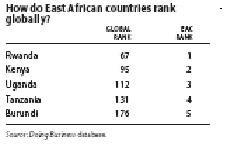
Rwanda is the most highly ranked economy to do business in the East African Community (EAC) region.  This is according to the Doing Business 2010 Report compiled by the World Bank and International Finance Corporation. The Report measures business regulatory reforms and this year  ranks Rwanda as the top reformer in the world, along with Egypt and Liberia, both in the top 10 global reformers list.  


The Report finds that the 5 EAC countries (Burundi, Kenya, Rwanda, Tanzania and Uganda) are undertaking regulatory reforms, even under the Common Market Protocol, but still have further to go and as such, no East African country makes it into the global top 30 economies. However Mauritius ranks no.17 globally and is the only African country in the world's top 30. 

Indeed, the average ranking for East African countries is 116th out of 183 economies overall. However performance varies across East Africa countries from Rwanda, which ranks 67th on the ease of doing business to Burundi, which ranks 176th.

What is interesting about the EAC report is that if each East African country were to adopt the region’s best practice for each Doing Business indicator, East Africa would rank 12th on the ease of doing business rather than 116th. In other words, if the best of East African regulations and procedures were implemented across the board, the business environment in East Africa, as measured by Doing Business, would be comparable to that in Thailand (12th in the 2010 global rankings on the ease of doing business). 

In recent years, EAC economies have intensified efforts to cooperate and learn from one another. They have also worked to harmonize legislation relating to the EAC Customs Union and even concluded Common Market Protocols.  Since a key objective of the EAC is to develop an effective common market, the Report provides a good basis for comparing regulatory performance across the region, and identifying how this can contribute to deeper regional integration.

The full EAC Doing Business report can be obtained here.

Trading the Nile River Rights

Following a decade of negotiations under the auspice of the Nile Basin Initiative, the Nile Basin States have opened an Agreement termed the Nile River Basin Cooperative Framework Agreement, for a period of one year. The Agreement is a landmark achievement given the decades of discontent over the inequitable sharing of the Nile River and will be open for signature until 13th May 2011. The organs consists of the Commission which is comprised of: (a) Conference of Heads of State and Government (b) Council of Ministers (c) Technical Advisory Committee (d) Sectoral Advisory Committees (e) Secretariat according to Article 17 of the Nile River Basin Cooperative Framework Agreement.


The River Nile is the longest river in the world with three main tributaries which reach ten African countries.  However the resource has been almost exclusively utilized by Egypt and Sudan by virtue of a 80 year old governing legal framework on the utilization of the waters.  The May 7, 1929 agreement between the United Kingdom (on behalf of its colonies) and Egypt, was in the form of exchange notes and the colonial-era “treaty” gave Egypt sole property rights to the Nile's waters, up until 1959 when Sudan formalized a partial-sharing agreement with Egypt.  Meanwhile the sources of the 6695 km Nile river consist of the White Nile which flows from Uganda (Lake Victoria) into Sudan, and Egypt, and the Blue Nile which starts in Ethiopia (Lake Tana) with tributaries in DRC, Kenya, Tanzania, Rwanda, Eritrea and Burundi, which flow into the Nile or into Lake Victoria.

Recently, a framework agreement has been agreed upon by Ethiopia, Tanzania, Rwanda, Uganda and Kenya who seek to alter the rivers’ water-sharing arrangements, with Burundi and the DRC promising to sign the landmark agreement in the course of the year. The upstream countries want to be able to implement irrigation and hydropower projects in consultation with Egypt and Sudan, but without Egypt being able to exercise the veto power it was given by the 1929 colonial-era treaty with Britain.  Meanwhile Egypt has reportedly rejected the agreement along with Sudan, however with the new Southern Sudan Government, its not clear how this matter will be handled by the latter.

I suppose the key issues in the newly concluded agreement are those of equity and sustainability. Consider for instance the riparian state of Ethiopia whose Blue Nile tributaries, highlands and lakes are estimated to supply about 86 percent of the total waters of the Nile River, however the country currently only uses about one percent of the Nile’s resources.  Ethiopia unlike most Sub Saharan African countries was not colonized and reportedly does not recognize the 1929 Nile River agreement between the UK and Egypt. Simultaneously the country is faced with grave development needs and challenges, and according to the World Bank 2008, Ethiopia has a real per capita GDP of US$280 (which is below the Sub Saharan Africa average) and a population of about 81 million making her the second-most populous country in sub-Saharan Africa. 

One could say that Ethiopia should view the Nile the same way other sovereign nations view their oil resources or mineral wealth; as a valuable source of foreign currency, development and national pride.  Along these lines, Ethiopia sees a huge potential in the export of electricity and is reportedly constructing a network of mega dams on the web of Nile rivers that tumble down from its highland such as the controversial 243 metres high Gibe III Dam (shown above) at a cost of 1.4 billion euros, which will be the highest dam on the African continent.  This is expected to meet the needs of the rural areas, where the bulk of the 80 million Ethiopians live and where only 2% of households get access to electricity.  Beyond hydroelectric power, agriculture and irrigation are other critical issues also relevant to the utilization of the Nile waters.

This is a complex and historic issue with many facets hence more can be said however, that would the subject of a thesis and not suitable for a blog.  To conclude, let me welcome this new Nile Cooperative Framework Agreement which is expected to formalize the transformation of the Nile Basin Initiative (NBI) into a permanent Nile River Basin Commission and facilitate its legal recognition in the member countries as well as regional and international organizations. 

NBI was formed in 1999 by its Members, who recognized their common concerns and interests, and whose vision is “to achieve sustainable socio-economic development through the equitable utilization of, and benefit from, the common Nile Basin water resources.” 

For a captivating analysis on this issue click here

World Bank's Open Data Initiative

The World Bank's new open data initiative can be accessed here.  The initiative is bringing global economic and development data to the web for the world to use.  As we all know, statistics are a key part of knowledge based decision making and thankfully comprehensive data about development indicators in countries around the globe is now easily accessible.

Africa Development Indicators can be obtained here.

World Bank Trade Website can be accessed here.

Sunday, May 23, 2010

2010 Economic Report on Africa Places Priority on Employment Creation

According to the UNECA Economic Report on Africa 2010, African countries must prioritize the creation of decent jobs as a central pillar of macroeconomic policy in order to attain the millennium development goals and eradicate poverty.  Few countries for instance have a ministry of job creation like Jamaica. For most people, gainful employment is the only way out of poverty. This is especially the case for youth and other disadvantaged groups. Unfortunately, unemployment and underemployment rates in Africa are high and continued to rise even during the period of rapid economic growth that came to an end with the global economic crisis in 2008.  In addition, Africa’s growth rates have not been accompanied by employment growth and as a result unemployment rates have remained stubbornly high and in double digits.

The Report also calls for appropriate investment in infrastructure and human capital, renewed and creative efforts at domestic resource mobilization, factor market reforms, incentives to support private-sector employment and efforts to increase productivity and incomes in the informal sector.

The full report can be obtained here

Monday, May 17, 2010

Audio Visual Services

According to a 2010 global cinema survey conducted by the United Nations Educational, Scientific and Cultural Organization (UNESCO) Institute for Statistics (UIS), Nigeria has overtaken the United States for second place in the global production of motion pictures. India remains the largest film producer in the world, producing 1041 feature films in 2005 and 900 short films in 52 different languages and dialects.  The US has in the past been the next largest producer of motion pictures, however Nigeria is closing the gap, outperforming the US for second place.  For Nigeria this is certainly no small accomplishment. 


According to the survey, Nollywood produced 872 productions  and in contrast, the United States produced 485 major films. The three heavyweights were followed by eight countries that produced more than 100 films: Japan (417), China (330), France (203), Germany (174), Spain (150), Italy (116), South Korea (110) and the United Kingdom (104).

The explosive growth of Nigeria’s Nollywood film industry attracts considerable attention, especially for developing countries looking for alternatives to the US or European models of film production and distribution, which require considerable investment.  To begin with, Nigerian film makers uncovered a winning formula by relying on video instead of screen film in order to reduce production costs.  Additionally, Nigeria capitalized on economies of scale given its sizable domestic market and her exports to the African continent and the diaspora.  One reason for Nollywood's popularity in Africa lies with the South African-based cable television MultiChoice, which is a fee-based broadcaster to the continent with 24-hour channels dedicated to African content, predominantly Nigeria productions. 

I should note however that these developments are not necessarily a result of Nigeria’s participation in multilateral or regional trade in services agreements but rather a result of home-grown supply capacity, technology usage and application of low cost approaches.  Trade in services negotiations however, are useful for the elimination of barriers to trade where the capacity to supply a market is hindered by regulatory measures.  In this regard, trade in services negotiations at the WTO aim to increase the liberalization commitments undertaken by participating Member States.  However, the audio visual sector is one in which fewest WTO Members have undertaken specific commitments under the General Agreement on Trade in Services (GATS) and it attracts significant MFN exemptions; a reflection of the controversial and divergent policy and cultural views among Members. 


For instance the European Community has almost no multilateral commitments in this sector and in the EC’s EPA Services, Investment and E-commerce template, the EC has excluded the sector from the scope of the EPA negotiations with ACP countries, of which Nigeria is a Member.  African countries could however choose to include this sector in the EPA negotiations with a view to developing an international advantage in the sub sector.  However the EPA trade in services negotiations would need to give priority to the development of services supply capacity rather than traditional market opening.

As one would expect, the US is a demanduer in this area and has effectively used bilateral and regional services agreements to advance audio visual commitments undertaken by its FTA negotiating partners e.g. Morocco in the US-Morocco Free Trade Agreement of 2006.  However these bilateral commitments have not necessary resulted in increased multilateral offers in the WTO Doha round, even though the sector is a dynamic one. 

International trade in audiovisual services extends to the production (including processing and finishing), distribution (including broadcasting) and exhibition of motion pictures, television and radio services.  It also includes sound recording and other entertainment such as theatre, bands, orchestras etc and includes the sale of advertising or promotion services. Additionally, the WTO Services Sectoral Classification List termed the W/120 also includes Recreational, Cultural and Sporting Services sector, under which news agency services are classified as a subsector and hence can be considered alongside audio visual services. 

Sunday, May 2, 2010

A New Policy Approach Towards Africa Unveiled by AGOA Architects

Ten years after the enactment of the African Growth and Opportunity Act (AGOA), a coalition of its original architects and supporters have unveiled a comprehensive and ambitious new trade and economic policy to be presented to the Obama Administration, that would build on AGOA’s successes and expand the growing trade relationship between Africa and the United States.
The new policy proposal, entitled Enterprise for Development: A New Policy Approach Toward Africa, calls for the continuation of AGOA’s exclusive duty- and quota-free access to the US market for African goods, as well as policies to strengthen and grow indigenous enterprises in Africa and measures that support job creation, export promotion and prosperity in both the US and Africa.  
The main policy proposals include efforts to:
a) Expand and protect AGOA and make it permanent
b) Develop tax incentives and credits for US investors in Africa
c) Support regional integration through AGOA
d) De-link AGOA from the WTO Doha Round
e) Partner to revitalise Africa's agricultural sector
f) Make US aid smart and effective
g) Expand and reform the Millennium Challenge Corporation
h) Increase funding for US exports to Africa
i) Increase support for the Overseas Private Investment Corporation (OPIC)
The proposals recognise that the private sector is pivotal to the expansion of trade and investment and that efforts to support the US private sector as well could increase investment in Africa.
Additional information on this development can be found here

World Economic Forum on Africa: Dar es Salaam, Tanzania 5-7 May 2010

Tanzania will host the 20th World Economic Forum on Africa May 5-7 2010, which will be held for the first time in East Africa.  President Kikwete will host the meeting, which this year explores the theme “Rethinking Africa’s Growth Strategy”. President Kikwete said: “Africa is a continent full of potential; Africa has been growing despite the economic instability that is facing the world today. We will have the opportunity to examine the strategy of Africa for today to ensure that there is a better tomorrow.”  

The World Economic Forum has announced that nearly 1,000 participants from 85 countries will participate in the 20th World Economic Forum on Africa and the Forum’s Seventh Summit of Young Global Leaders will take place on 2-7 May in conjunction with the main event, whereby over 265 Young Global Leaders from over 70 countries representing business, government, civil society, arts and culture, academia, media and social entrepreneurs will participate. One day of the Summit will be devoted to “Learning Journeys”, which will give YGLs the opportunity to work with the Tanzanian government, civil society and private sector organizations on their challenges, innovations and models for social change.

2010 is a special year for both the World Economic Forum, which is celebrating the 20th anniversary of its Africa meeting, and Africa, which is marking 50 years since the start of the independence movement that transformed the continent’s geopolitical landscape.  Discussions will address how African nations are managing relations with key economic partners, with an increasing trend towards greater South-South cooperation. As Africa joins India and China in crossing the billion person mark, its young population, natural resources and market potential are catalysts for significant future growth and development. However, underlying blockages to social and economic progress must be addressed to harness this potential. Key issues include access to education, healthcare and affordable capital.

Debate will focus on new models of governance and a unified approach to ensuring peace and security in troubled areas and address how a more conducive business climate and regulatory reforms can encourage both local and international investment. In addition, the meeting is expected to discuss how can low-carbon, sustainable development plans can be designed for Africa’s economic drivers including its natural resources, agriculture and tourism.


The meeting continues a long-standing tradition of uniting African and global leaders to shape the agenda for the continent and in fact, the Forum’s Global Redesign Initiative, which allows business, political and civil society leaders to examine gaps in international cooperation and develop proposals to overcome some of these short-comings, will play a prominent role in this debate.

More information on this annual meeting can be obtained on the WEF website.

Saturday, May 1, 2010

50 Facts About Africa You May Not Know

Selected statistics from the World Bank Regional Report on Africa 2009

3
SSA GDP growth was 5.1 percent.  Angola had the largest growth at 14.8 percent while the lowest was Botswana with a negative growth (-1.0 percent).

5
Equatorial Guinea has SSA's highest GNI per capita ($14,980); Burundi has the lowest ($140).

9
Total trade as percentage of GDP is the highest in Seychelles, 283.4 percent and lowest in Central Africa Republic, 37.5 percent.

10
In two thirds of SSA countries, one or two products are responsible for at least 75 percent of the country's total exports.

11
On average, the merchandise export within trade blocs is 8.4 percent of total bloc exports.

15
South Africa uses the most electric power per person (4,809.0kW/h); Ethiopia uses the least (38.4 kW/h).

16
In 2007, Burundi has the highest proportion of women in its labor force (90.2 percent); Sudan has the lowest (32.8 percent).

21
For the period 2007, Zimbabwe has the highest adult literacy rate (91.2 percent); Mali and Burkina Faso have the lowest (28.7 percent).

29
In 2010, starting a business in Guinea requires 213 days for each procedure; it takes 3 days in Rwanda.

32
Firms identifying corruption as a major constraint was highest in Côte d'Ivoire at 75.0 percent, whilst the lowest is Ghana 9.9 percent.

30
In 2010, Sudan has the highest number of procedures to enforce contracts of 53; Rwanda has the lowest of 24.

48
Gabon has the highest forest area as a percentage of total land area at 84.4 percent, whilst Djibouti has the lowest at 0.2 percent. (MDG7)

49
South Africa has the highest carbon dioxide emissions of 414,649 metric tons, whilst Comoros has the lowest of 88 metric tons. (MDG 7)

For the rest of the list, visit the World Bank site here